
Graphic by Liam Hinck
The midrange shot is an art form. There’s nothing quite like watching a post-fade rise above the outstretched defender’s hand. As Michael Jordan told Detroit Pistons legend Rip Hamilton, “Rip adds that to your game. That’s the hardest play in the game of basketball to guard.” But some think the midrange is dying. The NBA is shooting more three-pointers than ever before, and fans think players have forgotten this pivotal part of basketball. In reality, the midrange game has never been more beautiful.
If basketball was like boxing, then the midrange is your uppercut. It should be used situationally, thrown in a few times to make your opponent worry about it, opening up more chances for your bread and butter: 3-pointers and layups. It shouldn’t be the only tool in your arsenal; a boxer isn’t going to win their fight by only throwing uppercuts.
The best scorers to touch the court maximize their opportunities to take the highest percentage shots. An elite midrange ability is a frightening weapon, as defenders must stay aware of it as they guard. If at any moment, a player can fire a midrange over your outstretched hand and make them at a 50% success rate, you’re going to worry. This worry is what separates the best scorers from the rest of the league, they can attack from anywhere on the court.
The caveat to the midrange is that it’s, to put it simply, too hard. Most midrange shots entail an off-the-dribble, contested jumpshot while the momentum of your body carries you away from the basket. Middies are also shot from odd angles, and the strength needed to make them feels awkward for most people. They require a soft, elegant touch, so you don’t overshoot them, but they’re not close to the basket like layups. Trying to keep that same touch over the typical midrange distance is extraordinarily difficult to master.
Your reward for conquering the extreme difficulty of making a contest midrange fadeaway 18 feet from the basket? Two points. The same as a wide-open layup directly under the basket that would have been easier to do. The risk-to-reward ratio is just not worth it for 99% of players, and the league has come to understand this in the last 25 years. According to the NBA, during the 2000-01 season, teams attempted 30.1 midrange shots per game. Compare this to the 2023-24 season, where teams on average shot only 8.8 midranges a game.
Players in the early 2000s were relying on the midrange too heavily, and soon, the “well” of the midrange was beyond dry. If you combine the overuse of middies with the shot’s high degree of difficulty, the league was disrespecting the art of the midrange — and the numbers back this up. In what people ironically herald as the prime of the midrange, Jerry Stackhouse chucked 895 middies and made a measly 35% of them. This calculates to about 0.7 points per shot, which is around the same value as a 24% 3-point shooter gets on the threes they jack up. Now, Stackhouse was shooting 11.5 middies a game; could you imagine if Zion Williamson, a 23% 3-point shooter, was averaging 11.5 threes a game? Fans would be calling for his head.
It was astonishing how many middies were jacked up throughout the league that season. Almost 100 players had over 250 attempts from the midrange in the 2000-01 season, with many of them going well beyond that number, while only 16 managed to hit that mark in the 2023-24 season. Based on this, the 2000-01 season surely had more players making 45% or more from the midrange than the 2023-24 season. The 2000-01 season had almost 85 more players qualify, so they had to have more players over the 45% threshold, right? Both seasons had nine players meet those criteria. If we bump this number to 48%, the 2023-24 season had seven players meet the criteria, while the 2000-01 season had just two.
Offensive efficiency during the early 2000s was a victim of the overdose of midrange shooting. The average offensive rating in the NBA in the 2000-01 season was a measly 103.8 — the second lowest it has ever been. Some argue the poor shooting was because defenses back then were more physical, so players couldn’t get to the rim as easily as they do now and had to settle for midranges. However, there was something bigger in play. It all goes back to “his airness,” Michael Jordan.
Six NBA Finals wins and zero losses were all everyone needed to see, they wanted to be like Mike. In 1996, Jordan shot 48.9% on over 1200 midrange attempts in what may be considered the greatest midrange season we’ve ever seen. All of the success and glory that came to Jordan inspired everyone to try and replicate him — but they couldn’t.
The midrange is an upper-echelon skill for players, but nobody will ever reach Jordan’s ability. It took a while for players to realize his ultra-high volume and efficiency may never be seen again. But, once they did, the 3-pointer became more prominent and the league’s average offensive rating skyrocketed to 116.1 in 2023-24. This has created the belief that the 3-pointer killed the midrange, but despite its underuse, the midrange is still alive and well today, but in a different way.
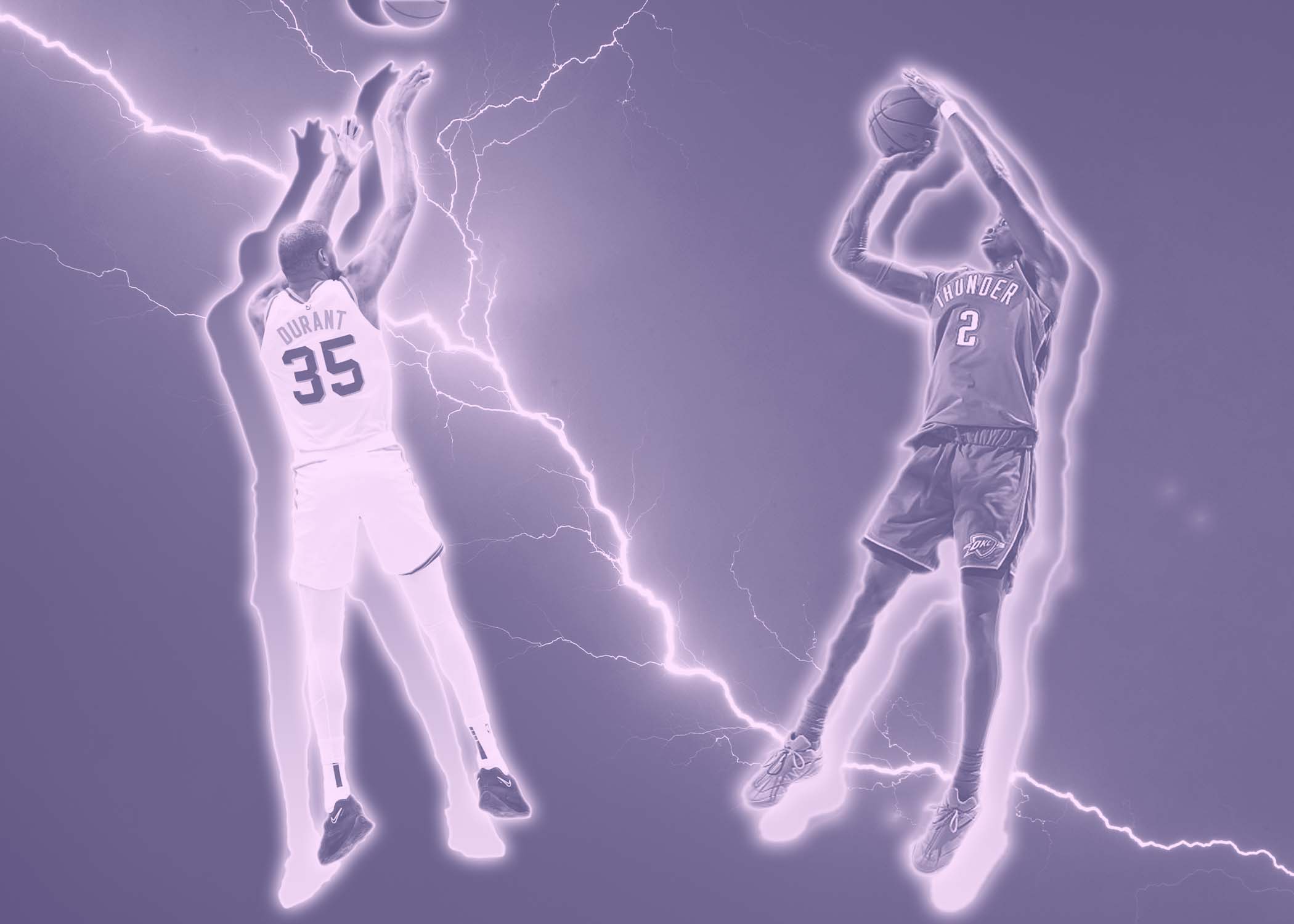
Two players in particular carry the torch when it comes to Jordan-esque midrange efficiency. Kevin Durant and Shai Gilgeous-Alexander were the most efficient high-volume midrange shooters last year at 51.8% and 49.4%, respectively. Besides Jordan, the NBA is reaching the pinnacle of midrange shooting. Players are using it in the way it’s supposed to be. Instead of being milked dry, the midrange is now the ultimate tool in the belt of the league’s best scorers. The number of midranges that are now shot is healthy, and the efficiency matches that. The midrange lives on not as a crutch, but as a calculated weapon in an evolving game.



Comments are closed.