
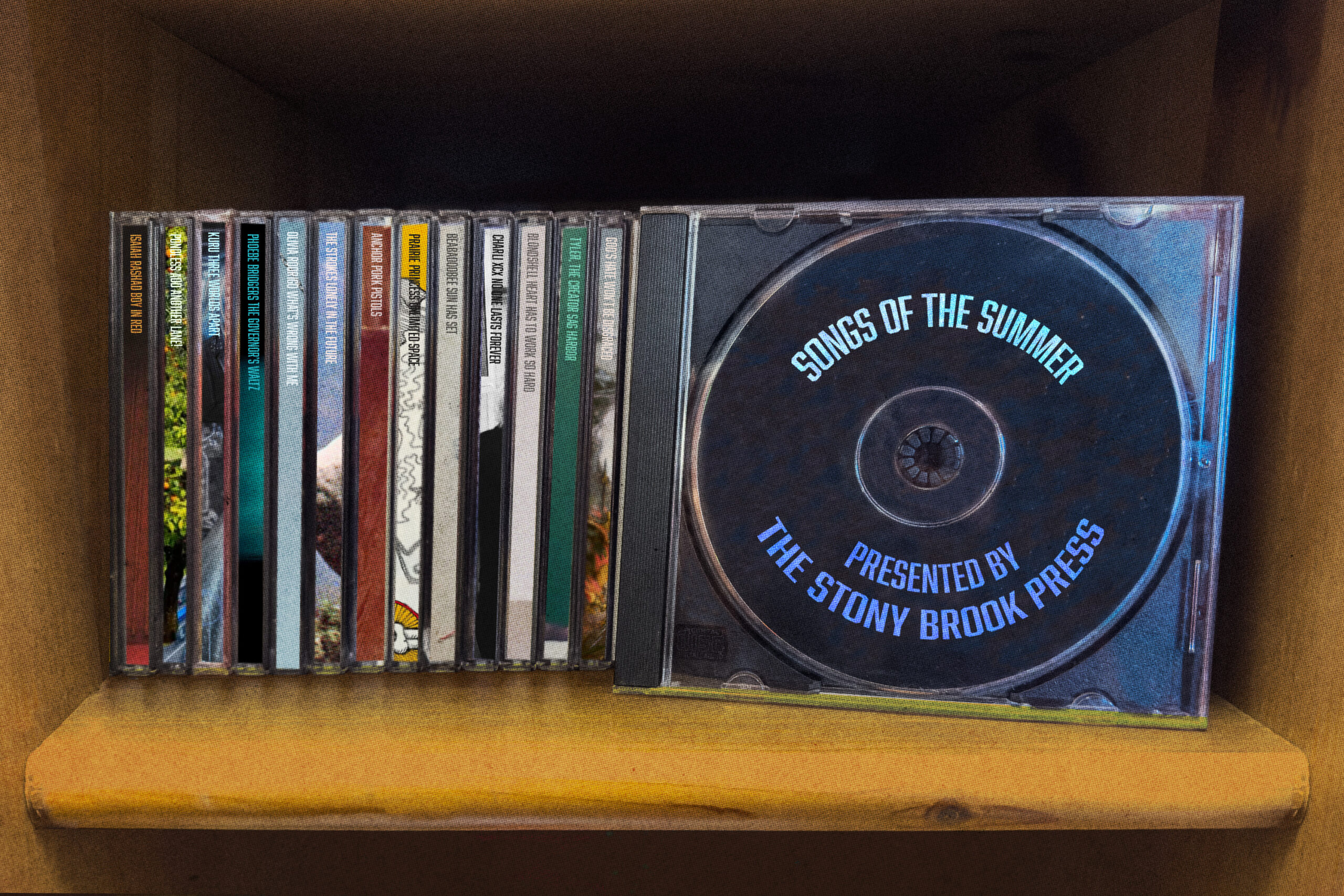
Graphic by Sonia Zahid
You know what they say: Summer is music. Okay, maybe nobody says that. But whether our writers were dancing under clear skies, sipping refreshing drinks or crying tears of joy or sadness, all types of music stuck with us. We’ve picked the best of the bunch. The Stony Brook Press presents part one of 2026’s Songs of the Summer.
BOY IN RED — Isaiah Rashad
by David Hodge
Fame has never looked good on Isaiah Rashad. Ever since he signed to California-based Top Dawg Entertainment in 2013, Rashad hasn’t been shy to feature the intimate lows of the high life in his lyrics.
The recording and release of The Sun’s Tirade, his debut album, was nearly derailed by Rashad’s struggle with mental health and addiction. In a 2016 interview, Rashad revealed his addiction to Xanax and alcohol nearly saw him dropped from TDE three times. These experiences provide a backbone to songs like “AA,” an introspective, moody confessional with lines like “This life I live, like — baby, don’t drink, like / Baby, don’t think too much, don’t drive.”
Unfortunately, the momentum from his debut record and 2021 studio album, The House is Burning, would soon come to a halt. On Feb. 9, 2022, two pornographic videos were leaked showing Rashad having sex with other men. Almost immediately, all the credit and respect Rashad had earned was at jeopardy.
Homophobia has always been one of hip-hop’s biggest problems, and although rappers have begun to stray away from the bigoted and hateful lines of the past, openly queer rappers like Tyler the Creator and Lil Nas X have had to fight twice as hard to be taken seriously. So maybe you can understand why I came into Rashad’s newest release, IT’S BEEN AWFUL, looking for answers. Would Rashad deride his haters, as is custom in hip-hop, or try to explain himself?
The album’s fourth track, “Boy In Red,” gives us one answer — it’s complicated. Among crunchy drums and lo-fi guitar licks sampled from “Didn’t Want To Have To Do It” by the Lovin’ Spoonful, Rashad speaks to an unnamed — and ungendered — lover. The song hints at Rashad’s fluid sexuality, with the track’s title even referencing singer-songwriter girl in red, one of the biggest queer voices in music today.
Then I could be your boyfriend
And if that doesn’t work
Then I’ll just be your girlfriend
As a longtime fan, I’ve always relied on Rashad’s hyperpersonal lyrics as an outlet for my own vulnerability. Even though Rashad’s lines are less specific this go-around, never giving us the full picture of his unnamed lover, his lyrical content and delivery still feature the melancholy so emblematic of Rashad’s life.
But this song is not just about his uncertainty — it speaks directly to his lover, reminiscing on how they make him “feel no pain,” as if he was “kissing nirvana,” a decidedly promising turn. I find a bittersweet hopefulness in this. If someone as unlucky as Isaiah Rashad can get a break from all the awfulness, then there is hope for all of us.
ADD ANOTHER LANE! — PONDLESS
by Cameron Roos
Whether you’ve nearly been turned into roadkill by the lack of sidewalks on Long Island or lost half your brain cells to bumper-to-bumper traffic, you’re probably familiar with Long Island’s flawed urban planning. However, you might not know the synth-pop band perfectly voicing these frustrations: Pondless.
Accompanied by the band’s groovy electronic tunes, the mesmerizing, reverbed vocals of Pondless’s lead singer and keytarist, Aaron Oliver, draw you into a musical journey. Combining comedic undertones with genuine passion for urban planning, his songs cover everything from the MTA to parking lots to Robert Moses.
His latest single, “Add Another Lane,” satirizes the issues with car-centric communities and the suburban model as a whole. The song begins with a sarcastic verse critiquing the United States’ gradual switch from close-knit, walkable towns and communities to large, sprawling suburbs.
Where a grove once stood
Stands a neighborhood
…
A town once one was torn in two
Destructed and never built a new
The pre-chorus mocks the mindset of an urban planner who sees the impending 4 o’clock rush hour traffic and can only ever think of one solution.
It’s 4 o’clock on a sundial
Oh, they say more road is overdue
This add-more-lanes mindset can bring us one step closer to a beautiful car-centric hell, where to exit the highway, you must precisely throw a banana peel out of the driver’s side window, thus allowing you to merge through 17 additional lanes before blue shelling the car ahead of you. Some argue this is just modern-day Los Angeles.
Building off this critique, Pondless argues for adding commuter rail systems to these areas as a far more effective solution for alleviating congestion. This is contrasted from the dystopian future he describes in the second verse, in which our car-centric societies have created such social isolation that anyone can disappear from public life.
Do you dream of the future?
Flying cars and giant buildings
Never go outside
They’ll never know if you’re still alive
As the bridge begins, the tune becomes more frantic and repetitive, mirroring a descent into madness caused by the relentless pursuit to add more lanes. His voice begins to echo, and the synth melodies turn sinister, almost haunting.
This spooky tone might remind you of the treacherous horrors of car-centric societies, but through the power of incomparably groovy keytar music, perhaps we can get one step closer to having gay little walkable European cities.
Three worlds apart — kuru
by Sonia Zahid
Nobody tells you how many rules there are to collecting records, well, aside from Reddit fanatics who love bashing beginners.
When I started my music collection a year ago, I settled on only buying CDs. They were relatively cheap, and I could store them properly. Internet forums scared me into avoiding vinyl completely. Apparently, they degrade at high temperatures and can’t be played too often. That was enough for me to check out. It’s not like I owned a vinyl player, anyway.
I stayed steadfast in buying only CDs, even if it meant ignoring a vinyl drop from an artist I adored. It was painful, but I kept telling myself it was the logical choice. How would I even listen to the record, anyway?
Honestly, it wasn’t all that different from the various arbitrary rules I upheld for myself. I prided myself on always being practical.
In a search to find more music for my collection, I listened to a lot of albums, most of which didn’t speak to me. But Backstage hologram by kuru, with its futuristic production and silly lyricism, kept me coming back. Sometimes, I would listen to the whole thing just to hear the last track, “Three worlds apart,” wrap the album up in a dreamy, enchanting tune.
When kuru announced a special vinyl pressing for Backstage hologram, I instantly bought it. I wanted to crawl out of my own skin for spending so much on something so useless.
I didn’t know it yet, but that choice marked a point of no return.
It was like something unlocked in my mind and drove me to make every stupid decision possible. I went to the mall with my friends even though I had a twenty-page paper due that night. I ate a mug full of chocolate ice cream for breakfast and dinner. I even bought a ticket to see kuru perform in the city.
The day of his concert, I spent $20 and three hours commuting there, then waited another three hours in the blazing heat. Maybe it was a waste of time, but when he finally took the stage and I got to hear “Three worlds apart” live, I knew it was worth it.
A month later, my vinyl arrived. It sits unplayed on my desk shelf, and it’s the best $40 decision I’ve made.
The Governor’s Waltz — Phoebe Bridgers
by Vik Pepaj
One of the most memorable relationships I’ve had was with my childhood best friend of seven years.
Living two blocks away from my apartment, she and I did nearly everything together. I’d spend every New Year’s Eve with her family, and my relatives overseas would ask me how she was doing without having ever said a word to her. Our lives were intertwined; she was everything to me.
Two kids in a trench coat living alone
I was too happy to feel at home
Dancing ourselves clean late New Year’s Eve
You deserved better, you wanted me
When we entered college, our friendship came to an end. Traditions dwindled, birthdays were forgotten and time got the best of both of us. There was never animosity, just an understanding that we were both holding on to a foundation laid down when we were 11.
When Phoebe Bridgers released the lead single off her album, Lost Weekend, two days before my ex-best friend’s birthday, it was kismet. Despite seemingly being about an ex-partner, “The Governor’s Waltz” beautifully illustrated what I’d been feeling: a bittersweet understanding that while endings are heartbreaking, some change your life for the better.
Don’t be mistaken — the song is heartbreaking. It’s produced with haunting instrumentals echoed by a chorus of oohs that leave you feeling like you’ve lost what Bridgers has lost: a future.
Lyrically, however, there is no true resentment or regret, only acceptance. In the same way my ex-best friend and I have curated new fulfilling lives without each other, so have Bridgers and her ex. It’s profoundly beautiful to have such an impact on one’s life despite your time together being cut short.
Since she took my place in my bed on that stage
I have not lost any sleep
Two days later, I played the song, opened our text thread and crafted a heartfelt message wishing her happy birthday. She sent a sincere thank you back. It’s a new tradition we’ll carry on for years.
She will most likely never read this article, but that doesn’t bother me as much as I thought it would. I hope a part of her loves me the way a part of me will always love her.
Happy birthday. I’ll text you in a year.
what’s wrong with me — Olivia Rodrigo
by Atticus Ball
Olivia Rodrigo’s “what’s wrong with me” from her album you seem pretty sad for a girl so in love shows how depression is more than just feeling sad.
With its poignant lyrics, melancholic instrumentals and feature by Robert Smith of The Cure, the song strikes a chord with those who’ve ever felt depression’s crushing weight on their chest.
While the lyrics’ themes are a bit on the nose, they are no less impactful. Rodrigo’s first verse on “what’s wrong with me” immediately puts the listener into her troubled headspace.
‘Cause lately I’ve been spiraling, oh
I’m not feeling like myself and
Nothing ever seems to help
The real meat of the lyrics comes through when Smith joins in on the chorus. The pair sing about symptoms of depression in lines such as “I’m not feeling like myself and / nothing ever seems to help” and “It’s like somebody put a weight on my chest” before the cause of Rodrigo’s sadness is revealed: her relationship.
In an interview with the BBC, Rodrigo said “what’s wrong with me” was originally about her missing someone so much it made her depressed, but she changed the lyrics once she realized the relationship itself was dragging her down.
Say I’m in love, so it’s hard to admit
I can’t eat, I can’t sleep
I think you’re what’s wrong with me
As if to avoid thinking about the doomed relationship, Smith takes over for the second chorus, trying to find a distraction from the ever-growing desire to end the imprisoning “love.”
But those feelings can’t be bottled up. They burst out in the final chorus where Rodrigo and Smith duet the track’s title five times in a row, as if the singers are finally accepting that their loves are poisoning them.
The track’s instrumentals are just as somber as the lyrics, with a slow percussion duo of piano and drums forming the sound. The beats are just slightly out of sync and sound almost like a heartbeat, speeding up during the chorus as emotions intensify. A lazy guitar riff comes through occasionally. The instrumentals are purposely tired and down, mirroring the lack of energy and spirit depression causes.
“What’s wrong with me” struck a chord not only because I’m quite the Rodrigo fan, but also because I can relate to it. Although I’m much better now, I can still remember the time when depression had its clutches on me; I had no interest or emotion in anything and felt detached. I was a spectator in my own life.
Depression can be overcome, though. For Rodrigo, it was ending her toxic relationship. For me, it was making connections and finding something in life to care about. “What’s wrong with me” shows that even though the sadness can seem insurmountable, there’s always a way forward.
Lonely in the Future — The Strokes
by Christiana Hadjipavlis
Growing up, I spent summers in Cyprus. For hours, I swam in crystal-clear waters and took in the sun with my grandmother, my yiayia. Last summer, I visited my family for the first time in five years.
I didn’t want to do it years ago, but I did
I did that yesterday when I was a kid
The Strokes released “Lonely in the Future” a week before my flight back to New York. When I first listened to it, I felt countless childhood memories wash over me. Nostalgia lives in the lyrics. It’s embedded in the autotune on the vocals, and it lights up in my mind when the chorus hits.
In the track, The Strokes reflect on the changing music industry. The way I’m thinking about this song is probably not what was intended, given it has its fair share of disses aimed at critics and other artists. However, the timing of the release made me think about how much Cyprus has changed since I was a kid.
Cyprus was both a vacation and a family obligation. Yes, I went to the beach every day, but I was also dragged to church on Sundays because it made my yiayia happy. I remember being put in the car and ushered into the pews. When I’d see her face during service because I couldn’t be bothered to pay attention, she seemed at home.
As home as she could be, at least. The neighborhood my dad grew up in is just outside Limassol, but he was born in Ammochostos, a city that he and his family were forced to leave when Cyprus was invaded.
My yiayia lived there for 40 years. As the years go by, I wonder how much she remembers of Limassol and Ammochostos. She was diagnosed with dementia a few years ago, and with every phone call and video chat, I see another piece of her memory chip away like nail polish.
In the past decade, Limassol has become a hotbed for development. Suddenly, the window I used to see the sunset out of only has a view of apartment buildings. In the same spirit of the music industry not being the same as it was, Limassol has become a place I don’t fully recognize sometimes. With my yiayia’s memory deteriorating, my family decided to take away her car, afraid she’d forget where she’s going while in the driver’s seat. She doesn’t go to church anymore. She hasn’t swum in years.
It’s lonely in the future
You don’t get it, it’s a pity
Every time I talk to my yiayia over the phone, I am reminded of how fleeting memories are. One day, I won’t be able to tell stories of what I did as a kid because I won’t recall any of it. I see my yiayia now, and if I’m anything like her, then everyone I’ve known will fade from my memory one day. At least for now, I can listen to “Lonely in the Future” on repeat while imagining I swam with my yiayia yesterday.
PORK PISTOLS — ANCHOR
by Steven Ospina Delgado
Typically, bands attract your ear with haunting lyrics, beautiful melodies and catchy grooves. But Anchor caught my eye first.
Let me set the scene.
Kids were playing soccer on the sidewalk, the sounds of dembow and beer bottles clanking filled the air and my mom was making a sweltering hot soup. It was an iconic Latino summer day. How was I spending it?
Laying in bed, phone in hand, scrolling through my perfectly curated Instagram feed.
I didn’t realize I was about to stumble upon the song I’d have on repeat to this very day: “Pork Pistols.”
Wait, what is it called?
I sloppily swiped to the next Instagram reel, ready to slightly breathe out my nose and move on. However, this one made me hold my breath.
Nick Lang, lead singer of Anchor, teleported around my screen with his brown and maroon-patterned guitar. A hand-written paper that simply read “Chug” flashed in various places, describing Lang’s aggressive strikes of his choked guitar strings.
Before I could process what was going on, Lang appeared in front of me, wailing into his microphone. A sketched crossword put his screams into words.
We can never really get this right
I was hypnotized, but I hadn’t even experienced the best part. Spelled out in bracelet beads, I read something that’d reel in any emo fan in the world.
“Midwest emo breakdown in 7, 6, 5, 4.”
As the numbers ticked closer to one, the tune increased in rage. The drums grew louder; Lang’s screams became more painful. Then came the breakdown.
Just like that, it was over. In such a short amount of time, Anchor took me on a visual journey. I felt like I was in Lang’s room and he was playing for me. Make no mistake, “Pork Pistols” on its own is as heartfelt as its marketing.
Might I remind you, dear reader, this was a 30-second Instagram reel. I’ll cut my explanation here, but I strongly suggest you watch the video yourself. Just know I damn near drooled from how entranced I was.
Going on the band’s Instagram will reveal this reel as one of their many gems. Whether Lang is jumping around his room bending colorful strings or jamming alongside his bandmates, Anchor’s page will have you scrolling until fall.
Anchor blew my mind this summer visually and auditorily, though, they left me with one question: Why on Earth would they choose the name “Pork Pistols?”
Sun Has Set — Beabadoobee
By Celia Liu
This summer, I found a widening gap between me and my friends whom I’ve known for years.
After months of no contact, I couldn’t convince myself to speak my mind. I was so focused on my responsibilities and romantic relationships that I neglected the connections I’d had since the start of high school.
That lack of contact created resentment, which fostered right under my nose. I’d sensed things were wrong in the past, but I never thought to say anything.
I felt as though I had no right to confront my friends. How could I when it had been months since we spoke? The only thing worse than a friendship that ends in explosive anger is a friendship left ambiguous — one where resentment had blossomed quietly. However, in the midst of my frustration, I found comfort in “Sun Has Set” by Beabadoobee.
Beabadoobee is best known for calmer love songs, such as “Glue Song” or “the perfect pair.” “Sun Has Set” is completely different. In fact, when I first listened to it, I didn’t like it. Yet, I chose to keep replaying it as I thought about my own life. I contemplated my faults and my anger toward my friends for leaving me in the dark. The relatability mixed with the initial sense of betrayal I felt brought me back to the song time and time again. Through this, I slowly realized just how beautiful it was.
Beabadoobee expressed in an interview that “Sun Has Set” was meant to be a hateful letter toward a person who wronged her. It was an expression of what she never said, and I loved that.
From the sun metaphorically setting on an old relationship to the fervent spam of angry, nonsensical words, Beabadoobee doesn’t express her feelings in clear sentences. Yet, she perfectly encapsulates raw emotion.
Steal
Weigh it down
Tough lovin’
Don’t let go of
The feelings too
Cold-hearted
Stay honest
Don’t be so fake and affected
The most impactful part of this song might be how the sun setting serves as a metaphor for her transition into a new genre of music and new chapter of life. One where instead of shrugging things off, she can explode with as much anger and resentment as she wants.
Though it still hurts, I know the setback I had with my friends is just a new start for me. I have so much more life to experience and many more potential friends to meet.
Don’t get me wrong, finding out your closest friends have been secretly conspiring behind your back is hard. But you know what hits harder? Beabadoobee’s transition toward a rock-influenced style of music. With the sunset comes sunrise, and I’m so excited for what’s to come for her — and for me too.
No One Lasts Forever — Charli xcx (feat. David Cronenberg)
by Emily Xie
Days before Charli xcx’s Music, Fashion, Film release, I found myself in the Chicago O’Hare airport, loitering underneath a (very fitting) “Food, Fashion, Film” advertisement. Much like Charli, I’d spent my summer shifting between mediums — riding in the car with volumes at unspeakable levels, reclining to gaze at cinema screens and sifting through vintage magazines. It wasn’t abnormal for my days to be overloaded with art.
Similarly, in Chicago, I was constantly on the move. From concert to museum to gallery, my earbuds were always in hand, and my mind was always racing to catch the next train and the next show.
It was part genuine interest and part overwhelming distraction. Scribbled X’s on my calendar served as a visual countdown for my journey onto a new campus. To avoid thinking about the future, I thought about art — always consuming and never creating.
She says, “No one really knows what the future holds
But we know nothing’s gonna last forever”
It wasn’t until my penultimate day in Chicago that a nighttime walk to Washington Square Park brought me out of my slump. Sat across the spouting fountain and surrounded by twinkling apartment lights, I realized my mind was the calmest it had been since the start of these dog days. As people shifted in and out of the park, I thought of the connections I made, drifted from and would create in the future.
As I was lying there on the sidewalk, I did not think about art at all
I— I thought about people, I thought about life
David Cronenberg’s reverberating monologue, though a sharp contrast to Charli’s synth-pop empowered vocals, is an intimate snapshot of his filmography’s philosophy and a fitting closure to her album. The serious endeavor and hedonistic passion intertwine into Charli’s contradictory approach to her art, leaving listeners with one final remark.
No one lasts forever
In her opening single for the album, “Rock Music,” Charli boldly proclaimed “the dance floor is dead” — a controversial statement for those who took those words at face value. As the architect behind 2024’s Brat, which cemented her into the musical zeitgeist of the decade, was Charli rejecting the cultural movement she, in part, spearheaded into the mainstream?
Ostensibly shifting genres, Music, Fashion, Film is at its core an electro-pop album that alters the tone of Charli’s work. Her recurring references to death in “Rock Music,” “Camera” and most pointedly, “No One Lasts Forever,” aren’t obsessions with the macabre, but ways of urging her audience to reject conformity. The dance floor isn’t dead, but Charli’s loyalty to Brat is. The finitude of time was her reminder to push stylistic and lyrical barriers; it was my reminder to take advantage of the future — the fleeting, yet fulfilling experiences to be made.
When my calendar proclaimed the end of summer, I found peace in my impermanence. As Cronenberg puts it best:
Oblivion is freedom
SAG HARBOR — Tyler, the Creator
by William Gonzalez
From June until school started, I worked full time in a wealth management office. With a commute consisting of up to two hours of train rides and walking, I had plenty of time to listen to music.
It was on one of these trips I discovered Tyler, The Creator’s “SAG HARBOR.”
The song hit streaming on June 22, right around when I settled into my summer routine. The Village of Sag Harbor is about ninety minutes from my house, but Tyler’s version of it is considerably more expensive than mine.
In the first verse, Tyler is looking at estates and acreage, flying to Martha’s Vineyard before deciding on Sag Harbor. Meanwhile, I was driving out there looking for parking and trying not to spend too much money on food.
But then, the content of the lyrics change.
I’m tired if we keeping it facts F*** work, bro, I need to relax
Peace of mind, what I need to get back
I obviously didn’t have $100 million to negotiate with a record label or a $3 million car to ship. But I understood being tired.
Tyler spends the song talking about accumulating lucrative things, yet keeps coming back to wanting freedom, wanting to settle down and wanting his mind back.
The production highlights that. There is almost no percussion. Instead, a warm sample from Cobra Heart Band’s “Cobra Heart” loops underneath without a huge drop or chorus. It just keeps going.
It sounds like joyriding.
You pass the same trees and roads until the drive becomes less about getting somewhere and more about getting away. I went to Sag Harbor this summer. I couldn’t afford the houses Tyler was talking about, but I could walk through the town and see the water. It helped me forget about work for a few hours.
The idea of getting away from everyday life, even for just a few hours, became what I liked most about the song. Underneath all the wealth, we’re talking about the same thing: wanting time that belongs to us.
I finished summer with more money than I started with, but less free time than desired. Now that school is back in session, I’ve started protecting empty time instead of treating every hour like it needs to be productive.
Sometimes the most valuable thing is time with nowhere to be.