
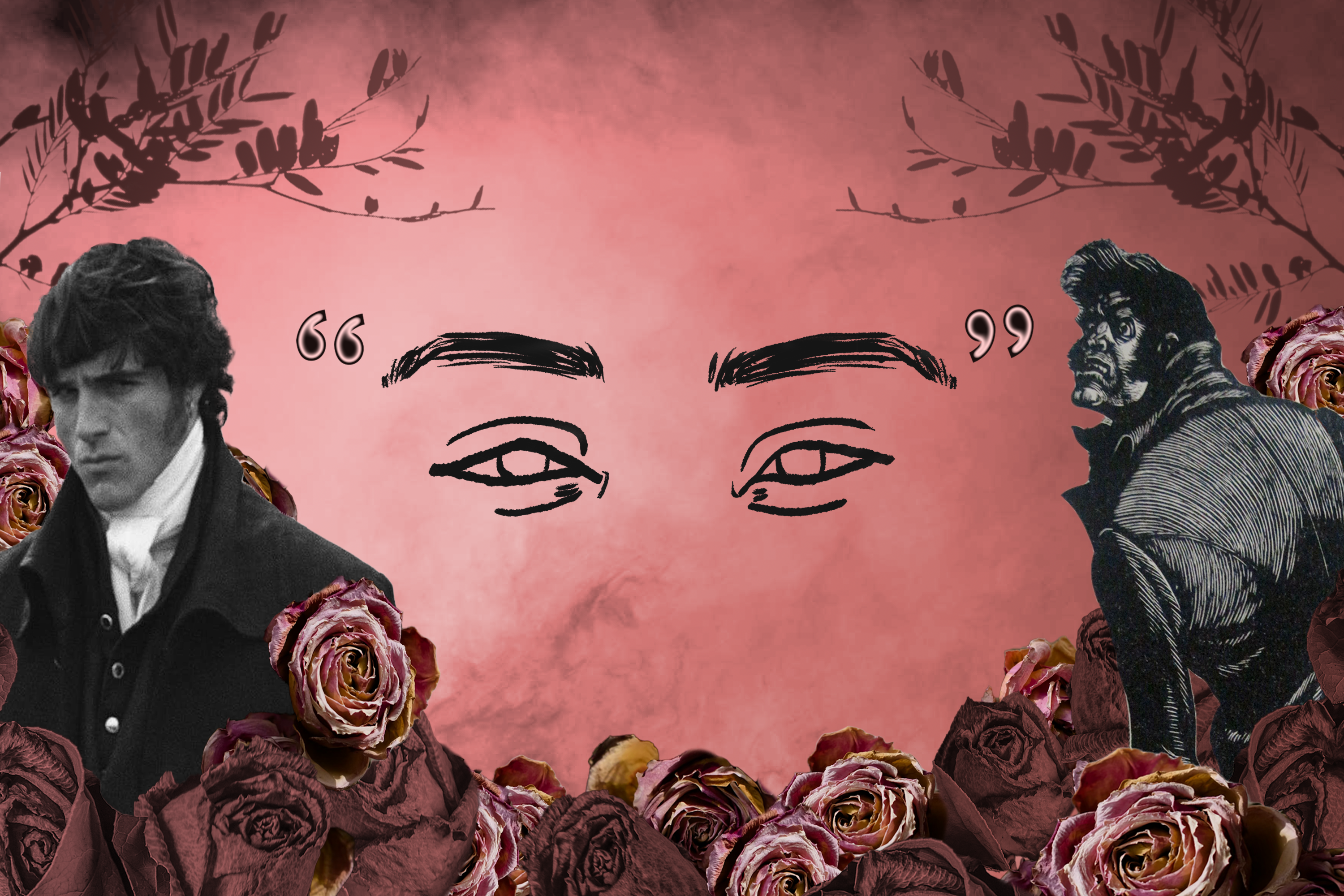
Graphic by Vik Pepaj
Critically acclaimed director Emerald Fennell may have jeopardized her new film’s success because of her self-fulfilling artistic oversight. The movie, slated to release Valentine’s day, is an adaptation of Emily Brontë’s novel Wuthering Heights.
The film’s first teaser trailer was met with immediate online criticism after its release in September. The general consensus was that Fennell’s most damning offense was casting Jacob Elordi as Heathcliff — a character who Brontë repeatedly describes as dark skinned.
One user on X shared their disappointment about Elordi’s casting and wrote: “heathcliff is described as a dark-skinned brown man in the book, and a major plot point is that he was subjected to racist abuse by his adopted family. but yeah sure jacob elordi is perfect!”
Brontë’s Wuthering Heights follows the dark romance between Catherine Earnshaw and Heathcliff as they maneuver life’s societal conventions in Yorkshire, England in the late 18th century.
Heathcliff, who is often shunned because he’s an orphan, is called a “beggarly interloper” and an “imp of Satan.” Throughout the novel, he is repeatedly called other derogatory insults such as: “savage,” “beggar,” “dog” alongside others.
In the novel, Heathcliff reveals his insecurities about his race, and compares himself to a white character, Edgar Linton.
“I wish I had light hair and a fair skin, and was dressed and behaved as well, and had a chance of being as rich as he will be!”
Race is an inherent aspect of Heathcliff’s personal development as a character and a necessary factor in understanding why the other characters treat him so differently. It’s confusing why Fennell believes Elordi can bring this character to life.
In her perspective, Elordi may be the actor who she envisioned would best fulfill this role, yet her decision to brush past the inherent racial identity attached to this character inadvertently speaks to a larger issue of how media tends to take a colorblind approach regarding issues about race.
On why she casted Elordi, Fennell says it’s because he “looked exactly like the illustration of Heathcliff on the first book that [she] read.”
When at the world premiere of Wuthering Heights, Fennell is asked the same question and elaborates on it further: “I think the thing is everyone who loves this book has such a personal connection to it, and so you can only ever make the movie that you sort of imagined yourself when you read it. I don’t know, I think I was focusing on the pseudo-masochistic elements of it.”
Fennell’s choice to erase Heathcliff’s identity is cowardly and avoidant. With Elordi cast, she has no obligation to address issues of racial prejudice within her adaptation and can focus on self-indulgently exploring elements of the novel she deems as worthy. Fennell can bring her Wuthering Heights fantasy to life while Brontë’s nuanced exploration of societal inequality is pushed aside.
Casting director, Kharmel Cochrane, has even gone on record to say, “[Y]ou really don’t need to be accurate. It’s just a book. That is not based on real life. It’s all art.”
Catherine and Heathcliff’s relationship is complex, messy and dramatic because their difference in class and race amplify the stakes. Without those stressors, the inherent risk of their relationship not being accepted amongst their peers is not there.
However, after the release of the official trailer in November, it’s now explicitly clear that Fennell is not intending for this film to serve as an exact adaptation.
The surreal set designs and inaccurate time period costumes are pushed to the forefront while the story’s essence is overshadowed by Fennell’s emphasis on contemporary aesthetics. However, the deliberate decision to showcase how loosely the film is pulling from the source material doesn’t excuse the whitewashing of its characters.
If creative teams behind projects like Wuthering Heights are so willing to abandon such an integral part of their protagonist’s identity, it signals that racial prejudice is a topic that is not interesting or worthy enough of being explored in their work.
Fennell’s artistic vision may have stunned the world with Saltburn, but her decision to cast Elordi as a means of fulfilling her teenage Wuthering Heights fantasy has setback the film’s potential of being recognized as a groundbreaking adaptation of the novel.


Comments are closed.