
Graphic by Liam Hinck
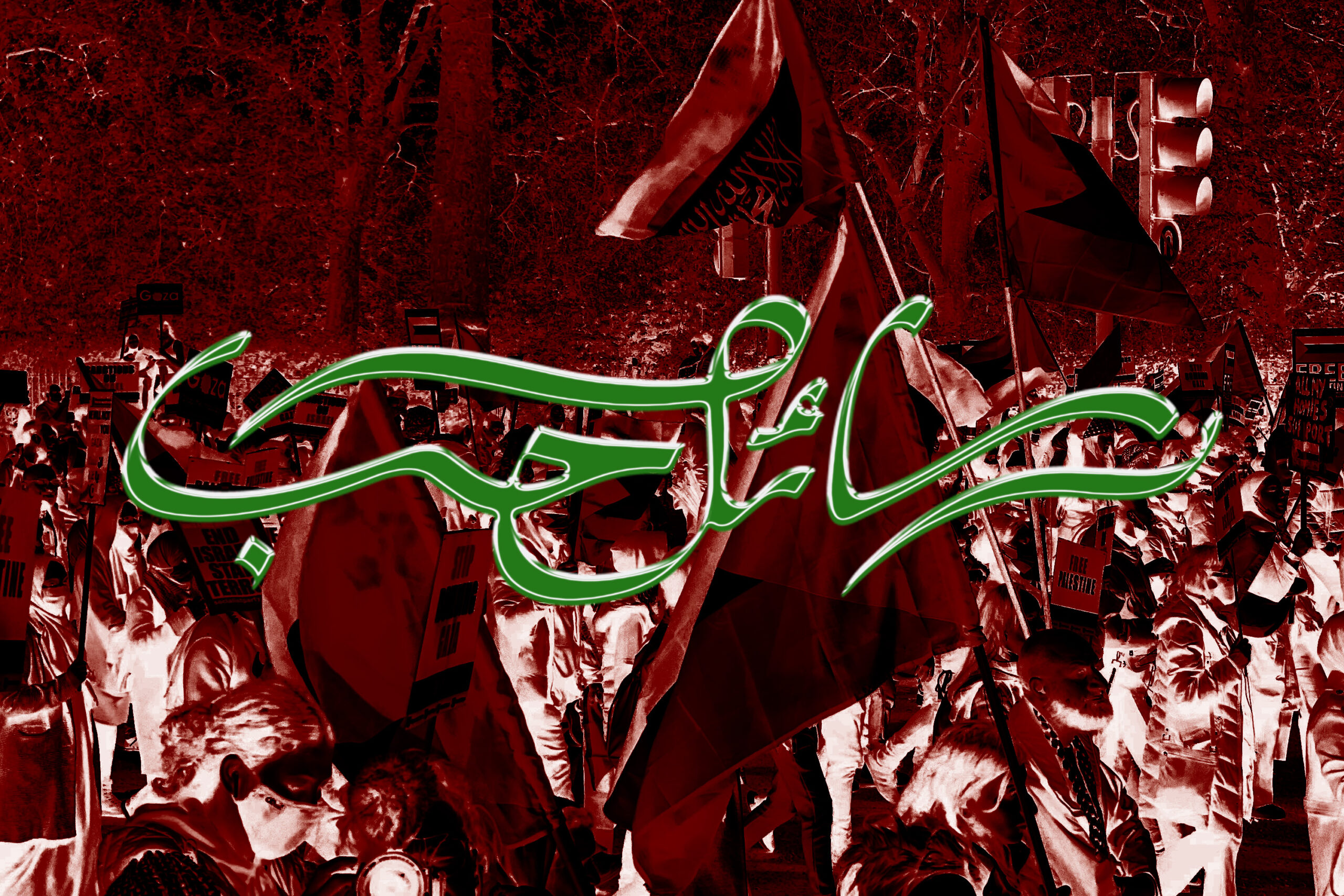
Up there on the stage of Terminal 5 in Hell’s Kitchen, Saint Levant looks like a hero, muscular and glimmering in the stage lights. The internationally acclaimed singer and rapper is sporting a black compression shirt, dark and baggy leather pants, combat boots and a vest that looks bulletproof. The audience is raptured, bearing flags sporting countries across the Arab world and beyond: the red blocks of Tunisia and Morocco, the black, white and green stripes of Jordan and Palestine.
Of course he looks heroic; of course his clothes insinuate bullets, insinuate combat; of course the waving of flags is both a feature of pride and a gesture toward survival. Saint Levant, a stage name coined by Marwan Abdelhamid and inspired by Yves Saint Laurent to paint his homeland as a place of prestige and class and reclaim the French colonial marker, is not quiet about how the struggle of Palestinians shapes his work. Born to a French-Algerian mother and a Palestinian-Serbian father, his album Deira was named for his father’s hotel built on Gaza’s seashore and destroyed during Israel’s war in Gaza.
Seeing him on that stage, I recognized something, and so did the rest of the audience. He was speaking directly to us — Arabs, Muslims, marginalized others — including us in something sacred, a celebration of culture specifically for us.
“Recognition” here comes from the late-15th-entury Latin verb “recognoscere”: know again, recall to mind. The prefix “re-,” meaning “again,” modifies the verb for ‘to learn.’ To recognize someone is thus to remember them, to acknowledge those whom you have already once met. It’s easy to give grace to people who look like us, who live around us, who talk like we talk; it is more difficult, and more necessary, to extend grace to those who may seem unfamiliar. What is a stranger but someone you have not yet met?
Abdelhamid’s first releases, aptly titled “Jerusalem Freestyle” and “Nirvana in Gaza,” are about life under occupation and push back against reductionist mainstream representations of Arabs on TV. More recently, he founded the 2048 Foundation to sustainably support Palestinian creators. His goal is to dismantle myths about conflict between Palestinians and Israelis that supplant a history of occupation supported by the US. He was speaking to those estranged from Palestinian humanity.
Protest and resistance are at the heart of his performance, and they are reflected back to him in the audience. It’s winter when he performs in New York City, but the hundreds who fill the room wear keffiyehs, Arabic calligraphy drawn across their clothes and hold up banners with the words “Free Palestine” and “Free Gaza.” Halfway through his set, during a lull, the audience broke out into protest chants, dancing to the beat of drums while Abdelhamid clapped along.
When I think about the songs I love, what draws me to them is a kind of resonance: a beat that’s easy to dance to, lyrics that strike home, sounds that transport me somewhere I want to go. There is a profound moment of recognition when a song articulates something you have never quite had words, sounds or even feelings for before. This is why people stuff hundreds of paintings inside museums, why there is an intern at Spotify making playlists for you, why whole schools and fields have been devoted to the history of sculpture and ballet and punk rock. Sometimes a song shows you that this feeling you have, this despair you are sitting with, this utter fascination or excitement, connects you to everyone else — connects you, at the very least, to the artist.
On the song “Nails,” Abdelhamid takes a victory lap, celebrating where he is now and where he came from. It’s a shake-off-the-haters song, full of reveling and not-so-subtle flexing. But at the heart of the song is an earnest critique: that the people Abdelhamid was once surrounded with never saw his potential, their judgement of him clouded by toxic masculinity, insecurity, and a disinterest in his real life, as opposed to the aesthetics or presentation of his life
And of course it hit me — the moment of recognition. Here is this Palestinian rapper, born in Jerusalem, a city I have never been to nor even been near, rapping about a pain I know so intimately. How strange, how incredible. I am a person who has never once painted his nails, not even considered it, but I know exactly what he is talking about. I have felt it, lived it. So of course I listened to the song incessantly — played it in the car whenever I drove, whenever I was in the passenger seat, queued it on my friends’ speakers at parties and when we were just studying. Of course I screamed the lyrics when he rapped to a cheering crowd in Terminal 5.
The song begins with a pulse. It’s a soft electronic sound, an echoey synth, that is propulsive: a strange mix somewhere between a dream-like echo and a house vamp. Then, Abdelhamid takes a deep breath. We hear it, feel it with him, before he starts his verse with the imperative “Listen.”
And I do. The track has a gravitational pull, slowly building and adding. It’s not until he’s wrapping up the first verse that we get a real beat. But then it’s there, and you feel so big with the bass under you. Abdelhamid’s lyrics are tongue-in-cheek, with a line disparaging how his girl doesn’t like that Mia Khalifa follows him. Khalifa, a former adult film actress who has since spoken out against the porn industry, features prominently alongside him in the music video for “Nails.” It feels powerful to ride Abdelhamid’s wave, to admonish his own critics alongside him.
Abdelhamid writes, “People that I knew in high school /Are now asking me for a job /But they used to hate on my nails.” His deep voice gives the lyrics a kind of gravitas, despite the tongue-in-cheek tone and despite the jokes elsewhere in the song. These people were so clouded by judgement that they never saw him. It took money and fame for them to actually acknowledge him. “How insecure / How sad of you,” he says later in the song.
As the track builds, Abdelhamid switches from English to Arabic and then later to French. It’s as if the longer the song goes, the greater the emotions and stronger the anger, the less able English is to hold what he’s feeling. It’s as though he needs the registers of Arabic and French to get there, to get across what this did to him, what it means for him now.
I have wanted to pierce my ears for years now. But I haven’t done it because I’m afraid of what people will think. I thought I was past this fear of judgement, that sometime after middle and high school I had learned to live off my own self-assurance. This is easier said than done. I constantly ask my friends if I would look good with pierced ears, and they constantly tell me that I would, but I get sick thinking about how my community would react — I even get sick writing it down.
The truth is, the people at my mosque are not quiet about what they think looks good and proper. A long beard, loose pants, medical school: good, proper. Pierced ears, gold jewelry, painted nails: not good and not proper. This is almost laughable compared to what I’ve heard sisters in the community have had to deal with, but it’s a lot for me — an invisible auntie looking over my shoulder and judging this and that aesthetic choice.
But this feeling of recognition pushes me beyond the mere aesthetic. What Abdelhamid says of appearance applies not only to what I wear but also how I act. So much of what I do is still rooted in a fear of judgement: how many protests have I sat out of, how many times have I bit my tongue to avoid being targeted by Zionists, to keep myself out of trouble while genocide escalates across the globe. With stakes like this, why do I care what people think?
And this pressure to adhere to social norms is, I suspect, the root of much larger issues. Recently, I have been thinking a lot about what makes it so hard for people to see the lives of Gazans as human lives, what has obscured the fundamental humanity of these particular strangers. But sometimes I want to turn off this thinking — sometimes I just want to forget about it.
The reason I listen to the same songs over and over — the reason it brings so much comfort — is because I know where they go: they don’t surprise or disappoint me. The problem is that indulging in that familiarity, allowing its comfort to shape my decision-making, closes me off from a whole world of expression. I put myself in a bubble: what music is to me becomes continually reinforced by my closed-off listening habits. And if this feels true of music, I can’t help but consider what else this applies to.
Another definition of recognition has to do with nationhood. In the early 19th century, “recognition” became a technical term in international law to describe whether an entity fulfills the conditions of statehood. To become a nation-state in the international community, Palestine must be recognized by other preexisting sovereign states. Sovereignty is something co-constituted. For a century, the world has agreed to not recognize their nationhood, in turn setting off this sequence of events to dehumanize and dismantle those Palestinians who exist regardless of the presence of an internationally recognized state.
We have the power to change our values. It’s hard to change a culture, but it happens. I don’t pretend to know exactly how, but I believe that art is part of it. In “Nails,” Abdelhamid is not reaching for the sympathy of strangers; he’s celebrating his self-assurance despite the doubt of his peers. And through that song, I felt something that connected me to him; I saw myself in the stranger.
About halfway through “Nails,” the song introduces a tabla. The goblet-shaped drum, also called a darbuka, has a distinctive percussive sound. The rhythms of the drums are always complex. Like the sounds of water flowing and dripping, the different notes produced on different areas of the drum create uniquely distinctive rhythms. Grounded by the resonant bass notes hit at the drum’s center, the drum is its own tapestry, which builds through the song until it closes it out, like a final explosive coda.
It’s a sound that may feel unfamiliar to you. For me, it reminds me of car rides with my dad listening to Bengali folk music. My dad who called to make sure I was being safe when protests erupted in universities across the country, many of which brandished those very drums for chants championing the Palestinian cause.
To protest, to stand for liberation and against occupation and genocide, is to place yourself in the public eye — to put yourself in a jeopardizing position, albeit one marked by media perception and professional responses rather than literal violence. Like wearing earrings, it feels to me a physical marker of a deeper rebelliousness, a bubbling up of a more urgent truth. But it’s something that my life is orienting me toward, it seems right, honest, good in a real sense of the word.
Up on that stage, a diamond stud glimmers like ice on Abdelhamid’s left ear. I’m beginning to see a path forward, to know where I’m wanted and how. I might just do it.

Comments are closed.