
Photo by Samantha Sanso
A few moons ago, I saw posts on X of users boasting the newest additions to their trinket collections. To my dismay, what the posters deemed trinkets were Calico Critters: durable plastic figurines you can find at nearly every big-box store. They are bought with names, genders and identities assigned to them by their manufacturer which can only be uncovered after tearing apart the plastic boxes they are sold in. Despite their antiquated look — Calico Critters often don Victorian-era clothes — and their miniature size, I was not convinced that they could or should be considered trinkets.
My strife with the Calico Critters was resurrected when I saw a bumper sticker that read “On my way to find a trinket that will fix me on the inside.” On the sticker were cartoonish graphics of a rabbit, a flower-decal mug, a dog, a Russian nesting doll and a tea kettle. It was adorable, but I thought about how some of these objects seemed too big, and more importantly, too alive, to be a trinket. My immediate thought was, “These items do not check the boxes of what a trinket is,” until I came to the startling realization that I was unsure what the classification of a trinket even was.
I have come to anthropomorphize trinkets, referring to them as small ornamental objects bought or found anywhere – they usually have a past life and an alluring story. A trinket can be obtained in numerous ways; visiting antique shops or second-hand stores allows one to find a trinket with unknown connections, leaving a sense of mystery to them. Or trinkets can be passed down generationally, favoring history over mystery with predetermined connections to the item. To me, all trinkets have an air of age to them, and if they have not yet fumbled in the hands of others and are instead bought untouched or in mint condition like Calico Critters are, they do not fit that criteria.
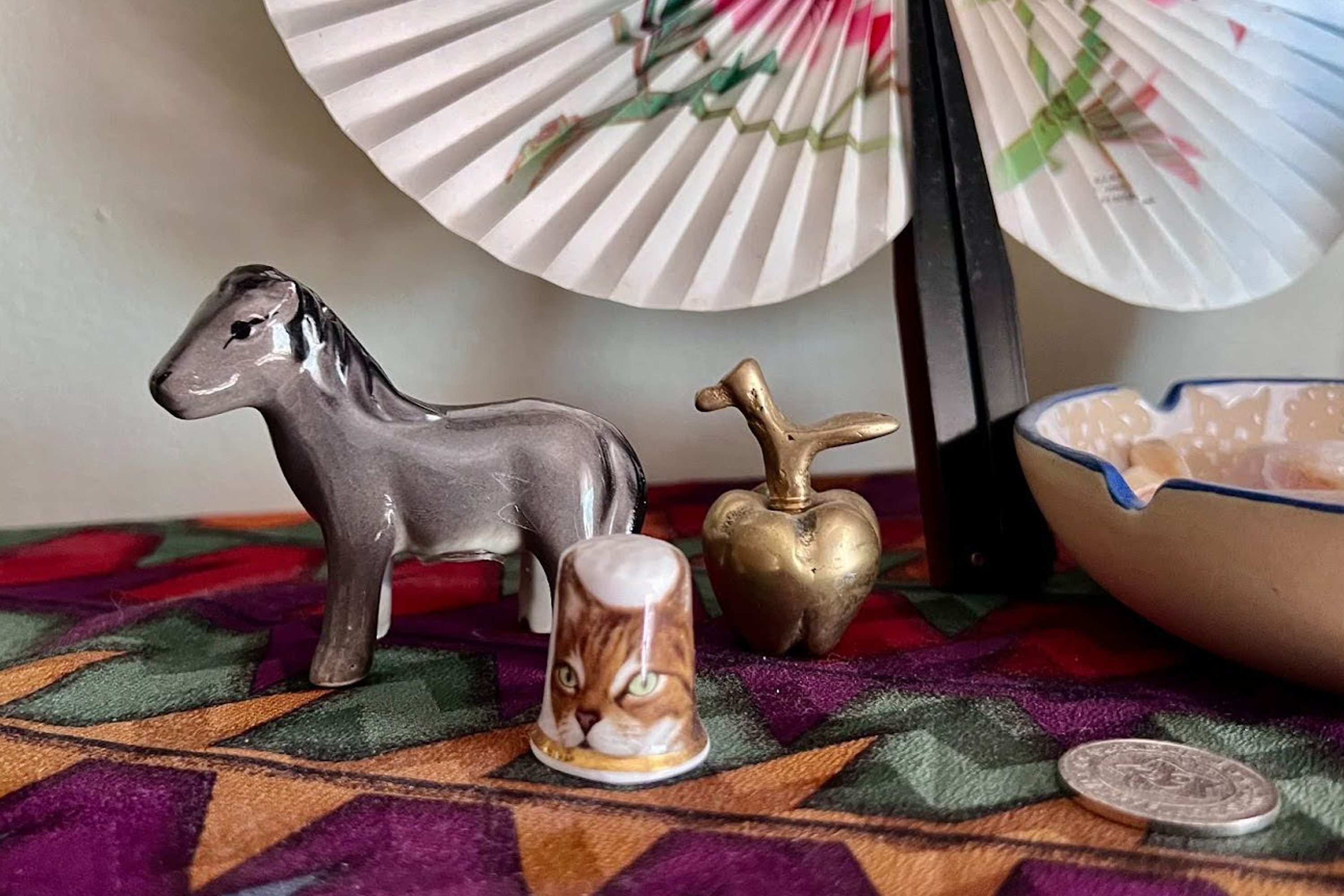
Trinkets have served as a multitude of things to a multitude of people, which is where I find value in them. While their utilitarian purpose may be minute, if existent at all, their decorative presence adds character to one’s personal space. My bedroom is filled with items that I consider to be trinkets, all bought or found second-hand, none of them alike. They have stories and sentimental attachments to them, making them more interesting to look at. Scattered across nearly every flat surface in my personal space are small items that I have attached a piece of myself to. I own a miniature porcelain horse figurine, hardly larger than a Calico Critter, that I found at an antique shop. Even though I have never been on a horse, I was drawn to this particular object due to its painted eye that amusingly appears to be made up with eyeliner. This miniature grey horse stands behind a thimble of a hand-painted cat that resembles my beloved pet. Next to these two trinkets sits a small and surprisingly heavy golden apple gifted to me by my mom, which was given to her with the purchase of a bamboo plant at a now-closed flea market.
My trinkets all emotionally resonate with me as they reflect my own stories and memories. If another individual owned these items, they would attach their own personal history to them, elevating the trinkets’ value in a different way.
Amusingly, when I looked up the dictionary definition of what a trinket is, the X poster and I were both incorrect. Referred to as “a small ornament (such as a jewel or ring)” and “a thing of little value” by Merriam Webster, a trinket can be semantically confined, yet it has expanded in many of our minds through a personal definition. Trinkets are not so easily categorized, transcending their dictionary definition and transforming them into objects with value determined by their possessors.
Personally, I have no attachment to Calico Critters, and I wondered if this is what antagonized me against their trinket classification. I asked family, friends, coworkers and fellow members of The Press if they considered a Calico Critter a trinket. For each firm “no” I received, there was an emphatic “yes!” that agreed with the X poster. There is a surprising amount of discrepancy in what we consider a trinket, and the opposing views we have towards each of these figuratively —and literally— small affairs led me down a rabbit hole. On my way down, thimbles, jewelry, Calico Critters, porcelain boxes and tea kettles — all objects people felt were trinkets, flashed before me. They tempted me to address the question: does the personal value projected on an item transform it from mere object to the desirable trinket?
To learn more about how trinkets are classified outside of personal spaces and the value we tie into them, I reached out to Emily Weiss, the owner of the eclectic vintage shop Beyond the Beaten Path in Eastport. The items in Weiss’s shop live up to the store’s name, as there is a wide array of vintage clothing, furniture and ornamental objects that could not easily be replicated or found anywhere else. Weiss has curated quite an impressive collection of quaint antiques, and at every turn there is the guarantee of finding a trinket.
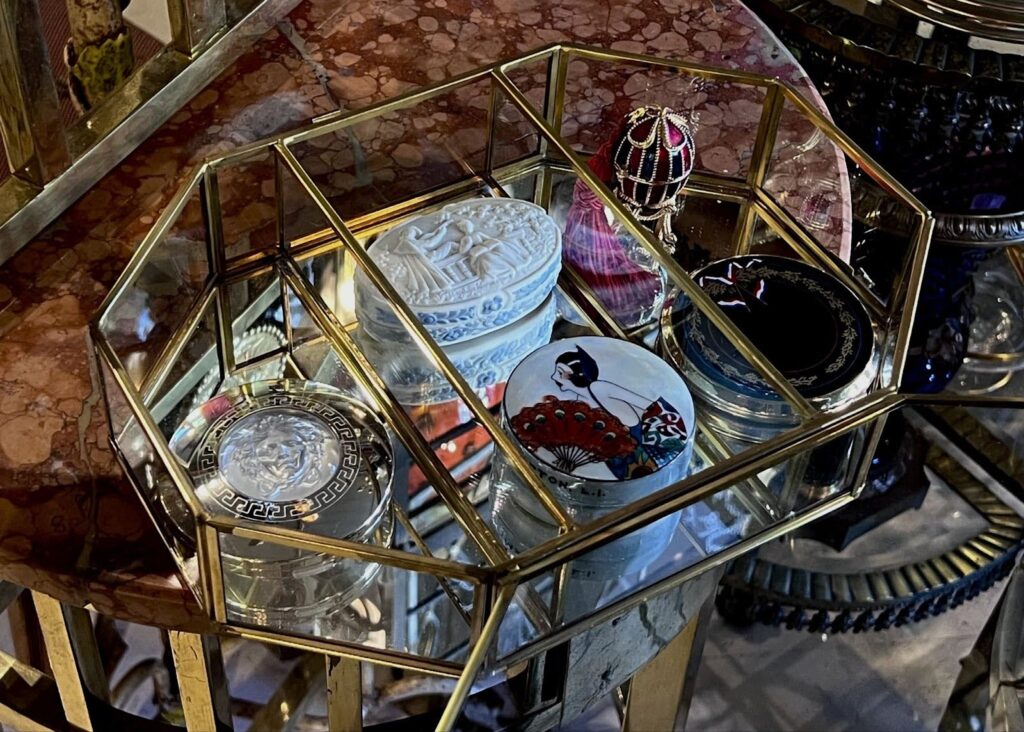
When I asked her what she considered a trinket, she took it upon herself to walk around the store and search for something that would fit her definition: “It would be something small that… Some of them are porcelain, some of them are metal, some of them are egg-shaped. I would consider those trinkets.” She asked me what the dictionary definition of a trinket is, and was surprised by her own disagreement with it. She said “Wow, that’s weird!” after denying that a trinket is meant to be worn.
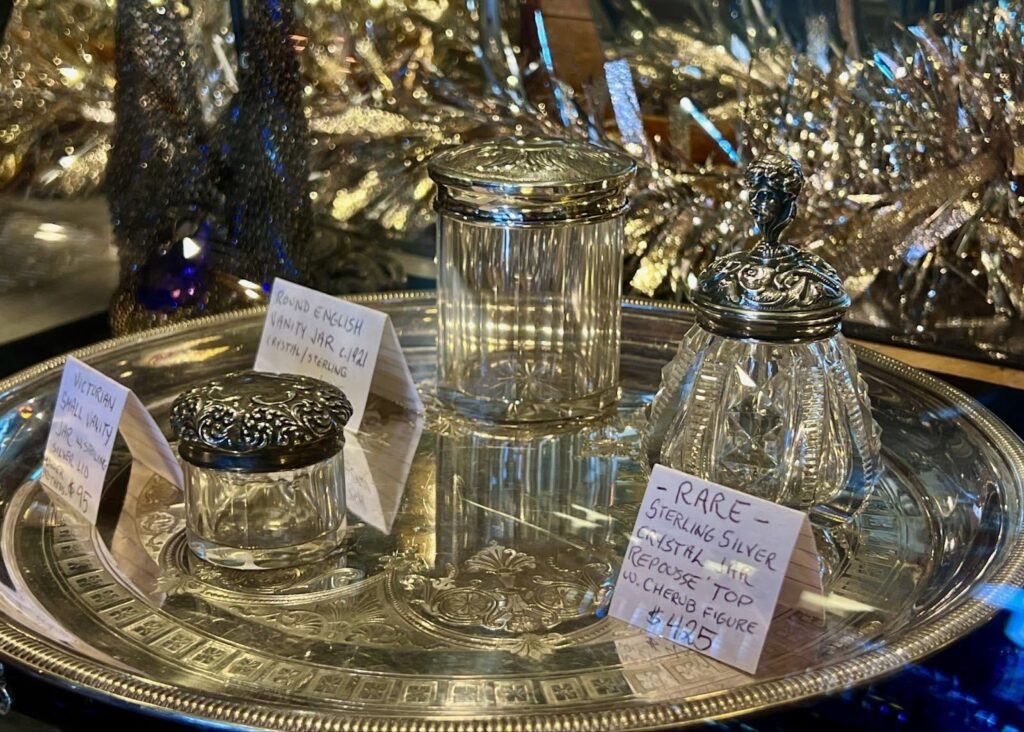
Carrying on around the store on her search for an answer, Weiss found more examples of items she considered trinkets. “I have Victorian dresser drawers. I think those would be trinkets also. They’re small and most of them have a sterling silver top. And I found a case that has some stuff in it, very small perfume bottles… I think those would fit into the category also.”
After finding items in the shop that she considered trinkets, I asked if she believed personal history and sentimental value were necessary criteria. “Personally I do, but I’m sure others will disagree.” She also said that she considers trinkets antiques that “could even be something that you give to someone as a gift. And maybe someone passed it down to you in your family.” However, the further down the rabbit hole she went in trying to define what a trinket was to her, she said, laughing, “I don’t know where to draw the line.”
I also inquired what trinkets in the store, or at home, Weiss feels the most connected to. She told me she has “about 5 million things” and could not think of her favorite off the top of her head, but she knew it would definitely be in her home. “Most of them would be in my bedroom, because it lends itself to that.” Like me, Weiss has placed her most valuable trinkets in her room, serving as totems of expression in the space that many of us feel the most comfortable.
Even though her most valued trinkets are at home, Weiss finds value in all the things she sells. “I am a collector first. I am not a dealer, and I don’t have a dealer mentality. When people come in and something isn’t for sale, they’ll say to me, ‘Oh everything is for sale!’ and I’m like, ‘No, it’s not!’ I’m a collector who sells, so for me, it’s collecting first, and I can’t part with my stuff because I’m emotionally involved. I left a note of apology for my kids in the attic.”
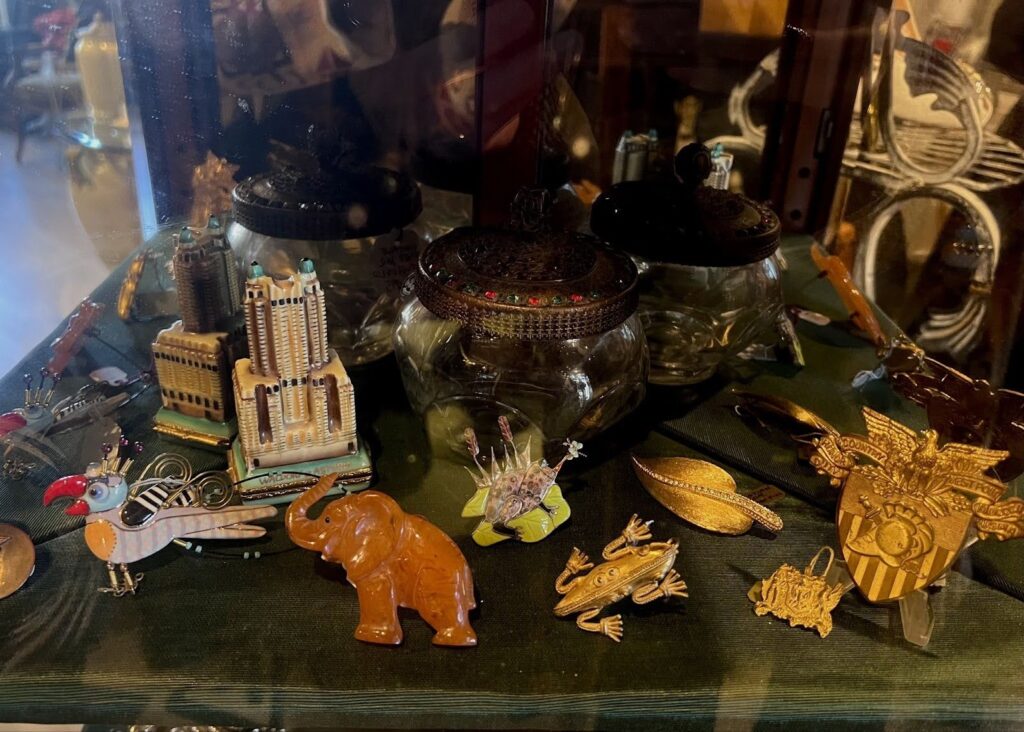
It appears most people have differing opinions on what they consider a trinket and it truly does reflect back on what the possessor deems valuable. Many of us feel a similar emotional involvement to our items like Weiss, which is why language sometimes fails us in accurately describing them.
Occasionally, trinkets are deemed interchangeable with other small objects, like tchotchkes, but the elusive trinket remains its own abstraction. The definition of tchotchke incorporates trinket to assist its definition, turning these objects into subsects of the trinket and potentially complicating the idea of what a trinket is. While the nature of the tchotchke is just as questionable, there is a kitschier connotation attached to a tchotchke as opposed to the daintiness of objects like trinkets. Tchotchkes are typically more durable than trinkets, composed from materials that do not easily shatter like plastic, rubber or silicone –hence the appearance of tchotchke shops in tourist-dense areas. Because they are not easily breakable and quickly replaceable, tchotchkes are sold more for kicks than sentimentality.
Further, the zaniness often associated with tchotchkes allows places like TGIFridays and Applebees to create a persona-based corporation and culturally (and economically) flourish. In both restaurants, American ideas and values are invoked by the decor that visually lunges at diners: walls adorned with road signs and license plates represent the open roads and vast expanses of land that comprise our nation, while Gumby figurines hammered into the wall remind us of the fun awaiting on the television at home. Pool balls and playing cards are also plastered around, inviting us to observe the slickness attached to long-enjoyed pastimes. Each item is removed from their intended environment — whether it be on the side of a highway, a dive bar, or a child’s bedroom — to carefully craft personality.
Many of the restaurants’ tchotchkes remind us of the nation as a whole, yet Fridays and Applebees also flaunt totems of local schools and sports teams to build a rapport with its diners. By relying on America’s consumer market — which allows a fascination with small, purchasable objects to flourish — and the wholesome ideas of community, the restaurants are able to mutate hokeyness into a marketing tool. The overwhelming amalgam of eccentric, familiar, and often garish decor creates a faux flair that would be unobtainable without the small items that populate the restaurant’s interiors. However, sentimentality as seen in trinkets is either underrepresented or distorted in places like Applebees and Fridays, hence the appliance of the trinket’s semantic substitute for decor.
Knick knacks have also come to be considered interchangeable with trinkets despite often lacking sentimental value. Like tchotchkes, knickknacks are defined as items of lower value and quality, making them accessible and not difficult to find. Things that we often consider knick knacks include toys in cereal boxes, Happy Meals and the items found when waiting in line in a big-box store. I would also venture to say that knick knacks can be obtained through quarter machines and range from sticky-hand toys to colorful ninja figurines. Knickknacks are typically made of plastic or some other polymer-based material, allowing them to be mass-produced and accessible in a variety of places. Because of this, a Calico Critter could more closely be associated with a knickknack. Knickknacks are something to fumble with in our hands in times of idleness and could even be disposable when our interest in them dwindles. Unlike the tchotchke, which is founded on quirk, and the trinket, which is valued for its sentimentality, the knick knack depends on accessibility for its appeal.
The artificial tchotchke charm of TGIFridays and Applebees, and the access to collectible knick knacks in our most frequented stores make places like Beyond the Beaten Path essential in the exploration of small objects we can connect with, specifically the trinket. Charming shops that preserve days past do not intend to craft a narrative for you in their trinkets. Instead, you are invited to find the trinket that most speaks to you and create your own, modern connection with these items. I do not know who owned the small porcelain horse before me, but that trinket has come to be one of the most beloved on my shelf. These small items often contain so much of our own personal history — and the history of others — that they cannot be replicated or sold for simple amusement. Whether obtained for an aesthetic purpose or not, they speak to and of the person who possesses them.
Trinkets continue to have an intangible quality that elevates them from other decorative items. They are not always bought for their functionality but for their ability to communicate an idea or memory that is in the making. Tchotchkes and knickknacks are potentially on the path to becoming trinkets, probably only a few heartbeats away, and if given time they could transcend that popular barrier. However, the allure of the trinket rests in its sentimentality. Our trinkets contain personal value that immortalizes our emotions in a tangible object, preventing our own histories from being lost down the rabbit hole of memory.


Comments are closed.