
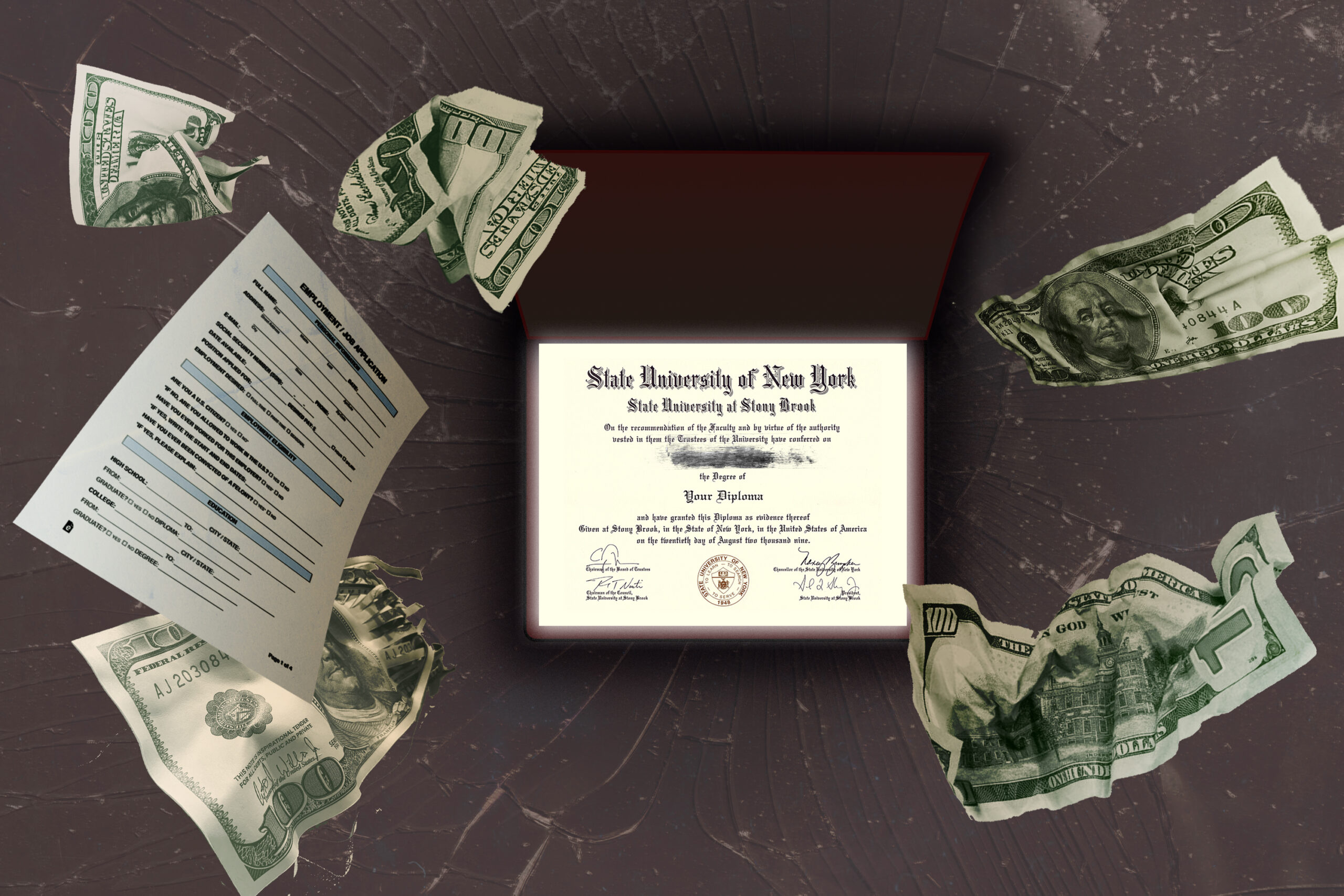
Graphic by Angie Cho
It’s not the cheapest time to be a college student. The total student loan debt in the U.S. is nearly $2 trillion, affecting a staggering 42.5 million Americans. The average borrower owes almost $40,000.
Recent college graduates face a job market that’s slowed in recent years, with their unemployment rates soaring past those of the rest of the U.S. population. With all these cataclysmic numbers, one might wonder: Is a college degree worth the hefty price tag?
With this pivotal question, it is crucial to consider the intellectual value of pursuing higher learning. Going to college isn’t purchasing a tool to unlock some lucrative professional future. Really, it’s buying a forge in which you, the student — a blank piece of metal — undergo a transformative experience, reshaping who you are and what you are capable of. College isn’t a master key, it’s what makes you one; and that in and of itself is priceless.
Before lauding the abstract intellectual and societal value of a higher education, it’s important to note there is still an inherent financial value in graduating from a university — a fact that seems to be increasingly overlooked in public discourse. More often than I can recall, there’s been clamoring for a repudiation of America’s higher education system.
This notable shift in the perceived value of college education has become a talking point for many influential figures on the right. The late Charlie Kirk, a prominent conservative activist famous for speaking at college campuses, said that “the vast majority of kids that go to college shouldn’t be there at all.”
The wealthiest man in the world and onetime “special government employee” for the Trump administration, tech billionaire Elon Musk, has called college “overrated,” saying, “I think college is basically for fun and to prove that you can do your chores, but they are not for learning.”
Many are left wondering — why waste the time, and more importantly, the money, pursuing a college degree when they are being told that they shouldn’t be there? Why choose a litany of chores over other avenues of economic success more readily available?
There are seemingly countless routes one can take to find financial paydirt in today’s society. Have a company pay your way through trade school, and you’ll quickly find relatively lucrative work as a plumber or an electrician. After all, somebody has to get paid to make the world go round. Or put your mind, passion and the innumerable power of the internet to use and pave your way as an entrepreneur or influencer, devoting yourself to some online exploit that could pay you to do what you love.
All of this is good and well, if you know what you want out of life and see a path forward. But to forsake higher learning simply because of perceived financial pitfalls is to deprive yourself of a flourishing financial future.
Of course, the cost of college in the U.S. can be exceedingly exorbitant. The price of tuition has far outpaced that of inflation over the past half-century, meaning the bloated cost of college increasingly seems out of reach for the average American. A price tag on an Ivy League education could run you a staggering quarter of a million dollars. That’s quite a sum, but it isn’t indicative of the average college student not attending an elite private institution.
There are numerous ways for a student to avoid the high-priced sticker of what’s thought of as a conventional college education. For one, 43% of college undergraduates attend community colleges. While this isn’t what many may have in mind when they embark on their academic journey, it can still serve as a fruitful and exceedingly affordable launching pad for their next educational stop, or even into the workforce.
There’s also the accessibility of online courses, which are now taken by some 26% of students exclusively, enabling them to take classes at a reduced cost, conveniently. Pell grants and financial aid, along with the digestible pricing of in-state public school tuition, also offer students a chance at a college education that doesn’t break the bank. That’s not to say these paths are effortless and without their own challenges, but it’s an opportunity for students to chase their dreams without feeling beholden to the financial restraints placed upon them.
The simple fact is that the long-term financial benefits of getting your degree still far outstrip any other alternative. College graduates earn substantially more than high school graduates. Individuals with a bachelor’s degree earn a median weekly income of over $1,500, more than twice that of those with only a high school diploma. Even with a depressed job market, the unemployment rate for all college graduates remains significantly lower than that of those without a degree. At the end of the day, college degrees still pay the bills despite the high price tag.
More importantly, beyond the financial advantages of pursuing a college degree, there are also the non-monetary considerations that may make it worthwhile. Going to college is not only a springboard into the professional world, but a time to cultivate who you are as a person and set a foundation for a more fulfilling life.
College makes living a longer, more engaging life, all the more accessible. Graduates tend to lead healthier lives, with lower rates of obesity and smoking, and can expect a life expectancy much higher than their less educated peers.
Graduates are also more likely to participate in their communities. Higher rates of volunteering, donating to charities and voting point to individuals more deeply ingrained in their communities and the world at large. This civic and communal engagement is indicative of a larger trend: that those who graduate from college tend to have a keener sense of how to improve their lives and the lives of those around them.
College, more than anything, is a time to expand your horizons, to experience a new way of thinking. It’s a chance for future accountants to take classes on Aristotle or Shakespeare, or for creative writing majors to learn about climate change or anthropology. It’s where you learn to think critically and deeply, gaining a better understanding of the world around you — equipping you not just for your future job, but for your future as a well-rounded human being.
If college is a forge and you’re a malleable piece of metal, then all the classwork, the tests, the challenging new ideas you come across, are all the heat and pressure of a blacksmith’s workshop. Just the right conditions to transform you into something new, something useful.
The people you meet along the way, the professors, mentors and classmates you work with, are the master smiths and their tools, hammering and bending and shaping you into a key capable of unlocking any door. Whether that door is your future career, some unforeseen endeavor or any of the obstacles and opportunities life will inevitably throw your way, you’ll be assured knowing you’re well-equipped to handle it.
Sure, there are a million reasons — or rather, tens of thousands of dollars — to consider whether or not college may be worth it. But it’s helpful to remember that, in the long term and under the right approach, there’s no safer bet. Even more crucially, it’s worthwhile to remember that it offers a transformative experience, a place to grow intellectually, socially and emotionally. And it’s impossible to put a price on that.



Comments are closed.